
Breadcrumb navigation


T cell Epitope Prediction
Comprehensive T cell epitope prediction, modelling the complete pathway from antigen processing to T cell recognition.
Our Approach
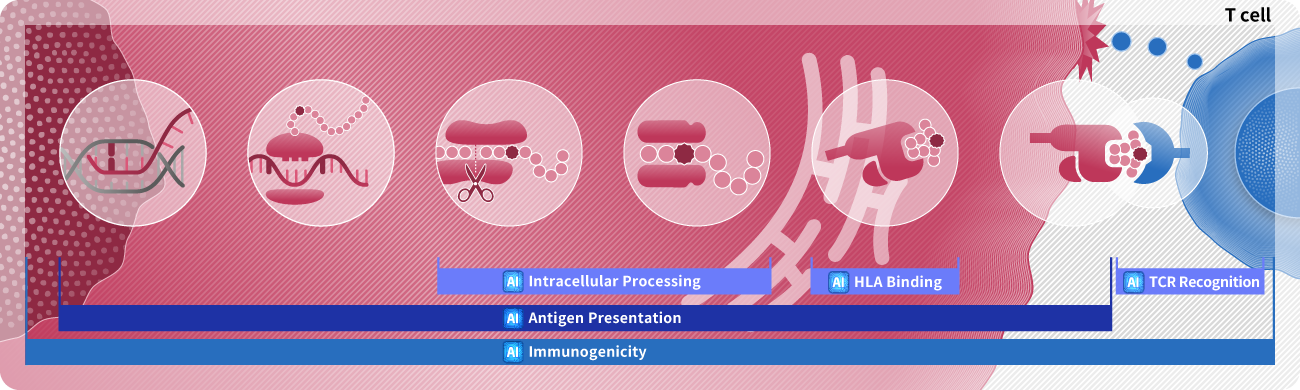
NEC Bio's platform models the full recognition pathway instead of reducing prediction to a single step. Predictions span a broad range of HLA alleles, supporting applicability across diverse patient populations. Based on public and proprietary datasets, NEC Bio has developed a sophisticated software system powered by machine learning algorithms designed to forecast which antigens possess the necessary characteristics to prime an effective T cell response, making them viable clinical targets for immunotherapy. Unlike other approaches, each step of the immune system is emulated, leading to priming of effective cellular immunity. The core components which rely on machine learning, will be explained in detail in the following sections:
Why T cell Epitope Predictions Remain Challenging
Predicting which peptides will genuinely prime a T cell response is difficult for several reasons:
- A multi-step recognition pathway – Determinants of cellular immune response are complex and highly regulated : antigens must be expressed, processed, loaded onto an HLA molecule, displayed at the cell surface, and engaged by a matching receptor in the patient's T cell repertoire.
- Binding-only prediction over-predicts – Most tools model just one step, binding affinity to HLA, and so return large numbers of binders of which only a small fraction are bona fide epitopes, investing time and resources into validating candidates that were never viable.
- HLA is complex – HLA and HLA expression are highly heterogenous across individuals, and Class II (CD4) behaviour is especially hard to predict
HLA Binding
The critical step in determining whether an antigen can trigger an immune response is its ability to bind to HLA molecules, because only HLA-bound peptides are recognized by circulating T cells. The HLA binding module predicts the binding strength of a peptide to specific HLA alleles. The module ensembles several distinct binding affinity predictors, to deliver optimal performance for both class I and class II alleles.

Intracellular Processing
For an antigen to bind HLA and be displayed on the cell surface, it must first be created through the cleavage of its parent protein by the proteasome in the cytosol and then transported into the endoplasmic reticulum by TAP transporters. The processing module includes several machine-learning models trained on extensive mass spectrometry immunopeptidome data to evaluate the probability for a given peptide to result from proteasomal activity, and hence to be available for presentation. This step ensures that predicted epitopes are not merely immunoreactive, but also that these peptides are actually relevant to the disease context and processed by the target cell.

Antigen Presentation
For a candidate antigen to activate a T cell, it must be displayed on the cell's surface bound to an HLA molecule. The key factors influencing this process include: (1) the binding strength between the antigen and a specific HLA molecule, (2) its efficiency in being processed by the antigen-processing machinery, (3) the expression level of the protein containing the mutation, and (4) the ability of the source protein to provide peptides to the antigen-processing pathway. NEC Bio has developed a machine-learning algorithm that has learnt the interplay between these different variables for any given HLA allele and can determine the probability of an epitope being successfully presented on the at the surface.

TCR recognition
The last determining step of priming a T cell response is the existence in the patient T cell repertoire of clones with a T cell receptor (TCR) having sufficient binding to the target presented peptide. TCR clones existing in a patient result from a stochastic genetic recombination mechanism further filtered by deletion of clones able to recognize self-peptides. Therefore we model TCR recognition to selection relevant targets.

Immunogenicity
Integrating expression, processing, presentation and TCR recognition, the immunogenicity module evaluates, for each sequence, the probability that it is a bona fide epitope, meaning that it will induce a T cell response that targets the relevant cell.

See the T cell Epitope technology applied
Explore how our T cell epitope platforms are being applied in cancer and infectious disease applications.